@TOC
函数(缩放误差)
传统的均方误差(MSE)和平均绝对误差(MAE)对所有预测值给予相同的权重,但在某些场景下,更关心相对误差而非绝对误差。缩放误差通过将误差除以真实值来实现这一目标:
缩放误差 = (真实值 - 预测值) / max(真实值, 阈值)这样设计的优势:
- 对于大数值和小数值的预测给予相对平等的权重
- 避免大数值主导损失函数
- 更适合预测范围变化很大的场景
数学原理
损失函数定义
设损失函数为:
L(y, ŷ) = ((y - ŷ) / max(y, threshold))²其中:
y是真实值ŷ是预测值threshold是防止除零的最小阈值
梯度计算
对于梯度提升算法,我们需要计算损失函数对预测值的一阶导数(梯度)和二阶导数(Hessian):
设 d = max(y, threshold),e = (y - ŷ) / d
- 一阶导数(梯度):
∂L/∂ŷ = -2e/d - 二阶导数(Hessian):
∂²L/∂ŷ² = 2/d²
评估指标
配套的评估指标使用缩放平均绝对误差(Scaled MAE):
Scaled MAE = mean(|y - ŷ| / max(y, threshold))LightGBM实现
自定义损失函数
python
def custom_loss_squared_lgb(y_pred, train_data):
    """
    LightGBM自定义缩放均方误差损失函数

    参数:
        y_pred: 预测值数组
        train_data: LightGBM的Dataset对象

    返回:
        tuple: (梯度数组, Hessian数组)
    """
    y_true = train_data.get_label()  # 获取真实标签

    # 计算分母,防止除零
    denominator = np.maximum(y_true, threshold)

    # 计算缩放误差
    error = (y_true - y_pred) / denominator

    # 计算梯度和Hessian
    grad = -2 * error / denominator
    hess = 2 / (denominator ** 2)

return grad, hess自定义评估指标
python
def mae_metric_lgb(preds, train_data):
    """
    LightGBM自定义缩放MAE评估指标

    参数:
        preds: 预测值数组
        train_data: LightGBM的Dataset对象

    返回:
        tuple: (指标名称, 指标值, 是否越大越好)
    """
    y_true = train_data.get_label()
    denominator = np.maximum(y_true, threshold)
    error = np.abs(preds - y_true) / denominator

return 'scaled_mae', np.mean(error), False使用方式
python
import lightgbm as lgb
import numpy as np

# 参数配置
params = {
    'objective': custom_loss_squared_lgb,  # 使用自定义损失函数
    'boosting_type': 'gbdt',
    'num_leaves': 31,
    'learning_rate': 0.01,
    'verbosity': -1
}

# 训练模型
model = lgb.train(
    params,
    train_set,
    valid_sets=[train_set, valid_set],
    feval=mae_metric_lgb,  # 使用自定义评估指标
    num_boost_round=1000,
    callbacks=[lgb.early_stopping(100)]
)XGBoost实现
自定义损失函数
python
def custom_loss_squared_xgb(y_pred, train_data):
    """
    XGBoost自定义缩放均方误差损失函数

    参数:
        y_pred: 预测值数组
        train_data: XGBoost的DMatrix对象

    返回:
        tuple: (梯度数组, Hessian数组)
    """
    y_true = train_data.get_label()  # 获取真实标签

    # 计算分母,防止除零
    denominator = np.maximum(y_true, threshold)

    # 计算缩放误差
    error = (y_true - y_pred) / denominator

    # 计算梯度和Hessian
    grad = -2 * error / denominator
    hess = 2 / (denominator ** 2)

return grad, hess自定义评估指标
python
def mae_metric_xgb(y_pred, train_data):
    """
    XGBoost自定义缩放MAE评估指标

    参数:
        y_pred: 预测值数组
        train_data: XGBoost的DMatrix对象

    返回:
        tuple: (指标名称, 指标值)
    """
    y_true = train_data.get_label()
    denominator = np.maximum(y_true, threshold)
    error = np.abs(y_true - y_pred) / denominator

return 'custom_mae', np.mean(error)使用方式
python
import xgboost as xgb
import numpy as np

# 参数配置
params = {
    'booster': 'gbtree',
    'learning_rate': 0.01,
    'max_depth': 6,
    'random_state': 42
}

# 训练模型
model = xgb.train(
    params,
    train_matrix,
    num_boost_round=1000,
    evals=[(train_matrix, 'train'), (valid_matrix, 'valid')],
    obj=custom_loss_squared_xgb,  # 自定义损失函数
    feval=mae_metric_xgb,         # 自定义评估指标
    early_stopping_rounds=100,
    verbose_eval=50
)CatBoost实现
CatBoost的自定义函数需要用类的形式实现。
自定义损失函数
python
class CustomCatBoostObjective(object):
    """CatBoost自定义缩放均方误差损失函数"""

    def calc_ders_range(self, approxes, targets, weights):
        """
        计算梯度和Hessian

        参数:
            approxes: 当前预测值列表
            targets: 真实标签列表
            weights: 样本权重列表(可选)

        返回:
            list: [(梯度, Hessian), ...] 的列表
        """
        assert len(approxes) == len(targets)
        if weights is not None:
            assert len(weights) == len(approxes)

        result = []
        for index in range(len(targets)):
            y_true = targets[index]
            y_pred = approxes[index]

            # 计算分母,防止除零
            denominator = max(y_true, threshold)

            # 计算缩放误差
            error = (y_true - y_pred) / denominator

            # 计算梯度和Hessian
            grad = -2 * error / denominator
            hess = 2 / (denominator ** 2)

            # 应用样本权重
            if weights is not None:
                grad *= weights[index]
                hess *= weights[index]

            result.append((grad, hess))

return result自定义评估指标
python
class CustomCatBoostEval(object):
    """CatBoost自定义缩放MAE评估指标"""

    def is_max_optimal(self):
        """指标是否越大越好"""
        return False

    def evaluate(self, approxes, targets, weights):
        """
        计算评估指标

        参数:
            approxes: 预测值列表的列表 [[pred1, pred2, ...]]
            targets: 真实标签列表
            weights: 样本权重列表(可选)

        返回:
            tuple: (误差总和, 权重总和)
        """
        assert len(approxes) == 1
        assert len(targets) == len(approxes[0])

        error_sum = 0.0
        weight_sum = 0.0

        for i in range(len(targets)):
            y_true = targets[i]
            y_pred = approxes[0][i]

            # 计算缩放误差
            denominator = max(y_true, threshold)
            error = abs(y_true - y_pred) / denominator

            # 应用样本权重
            if weights is not None:
                error *= weights[i]
                weight_sum += weights[i]
            else:
                weight_sum += 1.0

            error_sum += error

        return error_sum, weight_sum

    def get_final_error(self, error, weight):
        """计算最终的评估指标值"""
return error / (weight + 1e-38)使用方式
python
from catboost import CatBoostRegressor, Pool
import numpy as np

# 创建数据池
train_pool = Pool(X_train, y_train)
valid_pool = Pool(X_valid, y_valid)

# 参数配置
params = {
    'objective': CustomCatBoostObjective(),
    'eval_metric': CustomCatBoostEval(),
    'iterations': 1000,
    'learning_rate': 0.01,
    'depth': 6,
    'random_state': 42,
    'verbose': False
}

# 训练模型
model = CatBoostRegressor(**params)
model.fit(
    train_pool,
    eval_set=valid_pool,
    early_stopping_rounds=100,
    verbose_eval=50,
    use_best_model=True
)框架对比
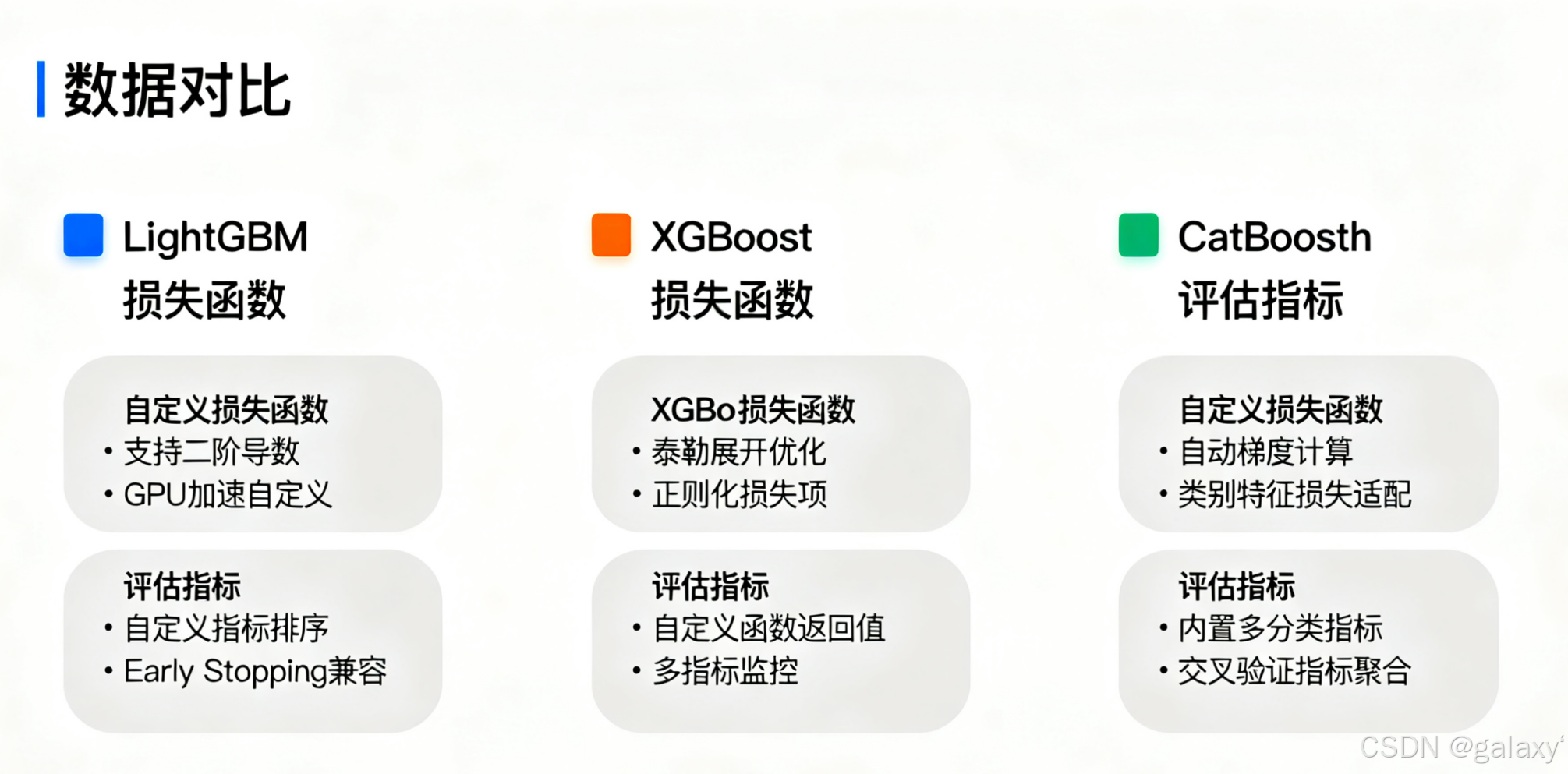
| 特性 | LightGBM | XGBoost | CatBoost |
|---|---|---|---|
| 损失函数形式 | 函数 | 函数 | 类方法 |
| 参数名称 | objective | obj | objective |
| 数据获取 | train_data.get_label() | dtrain.get_label() | 直接传入 targets |
| 评估指标形式 | 函数 | 函数 | 类方法 |
| 评估返回格式 | (name, value, is_higher_better) | (name, value) | error_sum, weight_sum |
| 权重支持 | 自动处理 | 自动处理 | 需手动处理 |
| 实现复杂度 | 简单 | 简单 | 中等 |
实际应用
适用场景
- 新能源功率预测:风电、光伏功率预测范围从0到满功率
- 金融风险评估:不同规模公司的风险评估
- 销售预测:不同产品类别的销售额预测
- 网络流量预测:不同时段流量变化很大
常见问题
1. 为什么要设置最小阈值?
问题:直接用真实值作为分母会遇到什么问题?
答案:
- 当真实值为0或接近0时,会导致除零错误或梯度爆炸
- 设置最小阈值可以保证数值稳定性
- 阈值的选择应根据数据的实际分布来确定
2. 梯度和Hessian计算错误怎么办?
问题:如何验证梯度计算的正确性?
答案:可以用数值微分验证:
python
def verify_gradients(y_true, y_pred, eps=1e-6):
    """验证梯度计算的正确性"""

    # 解析梯度
    denominator = np.maximum(y_true, threshold)
    error = (y_true - y_pred) / denominator
    grad_analytical = -2 * error / denominator

    # 数值梯度
    loss_plus = ((y_true - (y_pred + eps)) / denominator) ** 2
    loss_minus = ((y_true - (y_pred - eps)) / denominator) ** 2
    grad_numerical = (loss_plus - loss_minus) / (2 * eps)

    # 比较
    diff = np.abs(grad_analytical - grad_numerical)
    print(f"最大梯度差异: {np.max(diff)}")
return np.allclose(grad_analytical, grad_numerical, atol=1e-5)3. 不同框架的性能差异
问题:三个框架在使用自定义损失函数时的性能如何?
答案:
- LightGBM:通常最快,内存效率高
- XGBoost:稳定性好,文档完善
- CatBoost:对类别特征处理好,但自定义函数实现相对复杂
4. 超参数调优建议
python
# LightGBM调优示例
from optuna import create_study

def objective(trial):
    params = {
        'objective': custom_loss_squared_lgb,
        'boosting_type': 'gbdt',
        'num_leaves': trial.suggest_int('num_leaves', 10, 100),
        'learning_rate': trial.suggest_float('learning_rate', 0.01, 0.1),
        'feature_fraction': trial.suggest_float('feature_fraction', 0.4, 1.0),
        'bagging_fraction': trial.suggest_float('bagging_fraction', 0.4, 1.0),
        'verbosity': -1
    }

    model = lgb.train(
        params,
        train_data,
        valid_sets=[valid_data],
        feval=mae_metric_lgb,
        num_boost_round=1000,
        callbacks=[lgb.early_stopping(100)],
        verbose_eval=False
    )

    y_pred = model.predict(X_valid)
    scaled_mae = np.mean(np.abs(y_valid - y_pred) / np.maximum(y_valid, threshold))
    return scaled_mae

study = create_study(direction='minimize')
study.optimize(objective, n_trials=100)